
Introduction
Apple loves to brag about privacy. “Privacy first.” “Your data stays yours.” Bullshit. Behind that shiny Apple logo is a surveillance machine that tracks your voice, your location, your habits—and locks you into expensive hardware you can’t even repair. This article rips off Apple’s privacy mask, shows you what they’re really collecting, and points you to the only real escape: Linux.
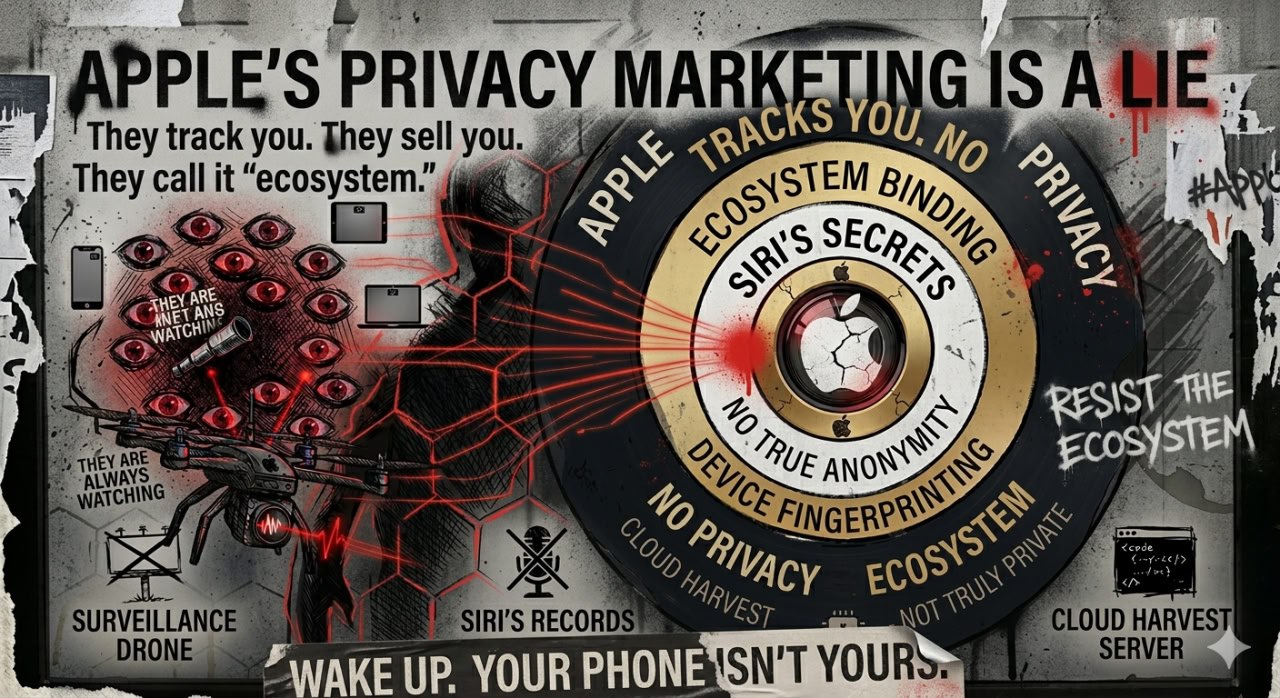
System‑Level Tracking: What Apple Really Collects
Apple’s “privacy” is just a marketing lie. They break their tracking into slick categories, but it’s all about vacuuming up your life:
- Everything you say — Siri listens, analyzes, and stores your voice data (even when you think she’s off)
- Everything you sync — iCloud integration is a one‑way data pipeline to Apple’s servers (and you can’t fully disable it)
- Your device fingerprint — serial‑number tracking ties every Mac, iPhone, iPad to your identity
- Your App Store life — every download, every purchase, every review tracked and profiled
Hardware Limitations: The Cost of Apple’s “Privacy”
Apple’s “privacy” comes with a brutal price tag—and not just money. You’re locked into hardware you can’t repair, forced obsolescence, and a walled garden that’s impossible to leave.
Here’s what that means:
- Expensive hardware with repair restrictions — DIY? Forget it. Apple makes sure you can’t fix your own device.
- Authorized repair costs a fortune — Apple’s authorized repair is a racket designed to keep you paying.
- Forced obsolescence — Older Macs can’t run the latest macOS, pushing you to buy new hardware every few years.
Apple ID Lock‑In
Apple pushes you to sign in with an Apple ID—hard. Yeah, you can skip it during setup, but then you lose iCloud, the App Store, FaceTime, iMessage, and a bunch of built‑in apps.
Once you sign in with an Apple ID, your Mac life gets tied to your identity across iPhone, iPad, iCloud, Apple Music—every Apple service you touch. They build a full‑on dossier of your digital existence.
Comparison: macOS vs Linux Privacy & Freedom
Here’s the brutal truth—side by side:
| Privacy Aspect | macOS | Linux |
|---|---|---|
| Data Collection | Extensive (Apple surveillance baked in) | None by default |
| Update Control | Mandatory, limited deferral | User‑controlled, can skip any update |
| Account Requirement | Required for iCloud, App Store, many features | No account needed |
| Advertising | Yes (Apple advertising) | No |
| Source Code | Proprietary, closed | Open‑source, auditable |
Actionable Steps: What Mac Users Can Do Now
You’re not helpless. Here’s how to fight back—right now.
Short‑Term Mitigations
Quick fixes that slap a band‑aid on the bleeding:
- Use Little Snitch or LuLu to block outgoing connections (band‑aid on a bullet wound)
- Turn off Siri, location services, iCloud sync—reduce the data firehose
- Use a local account instead of an Apple ID—don’t give them your name
- Disable Apple advertising ID, analytics sharing—tell them to fuck off
Long‑Term Solution
The only real way to win:
These band‑aids only slow the bleeding—they don’t stop Apple’s surveillance. For real privacy, you need to jump ship to Linux. Distros like Ubuntu, Fedora, or Linux Mint are easy to use and put you back in the driver’s seat—and you can run them on any hardware, not just Apple’s overpriced cages.
Conclusion
macOS is built for Apple, not you. Its surveillance is everywhere, baked in, and hidden behind shiny marketing. You can slap on third‑party bandaids, but the only way to truly own your privacy is to jump ship to an OS that respects your freedom—Linux.
Your data belongs to you. Take it the hell back.